Only 79,00€ away from free shipping
No products in the cart.

33,60 €
In stock (can be backordered)
Order within 13 h 59 min and we ship today
Arrives approx. Fri 9.10. – Tue 13.10. · to a pickup point or your home
Free collection in store, usually the same day
Enzymes are catalysts that speed up chemical reactions. They are usually proteins that are not themselves altered or consumed in the reaction, but instead act rather like specialised tools. Humans need enzymes in thousands of different processes. They accelerate vital reactions by breaking down or building up substances. Enzymes are essential for muscle growth and digestion, among other things. Proteases, for example, break down proteins, and lactase breaks down milk sugar, or lactose.
A healthy body produces enzymes as needed. They are also found in food, most abundantly in food that has not been heated. Papain is extracted from the papaya fruit, but enzymes for use in food supplements are also produced through natural fermentation.
Every enzyme has its own ideal environment in which it works best. Most human enzymes work best at a temperature of around +37 degrees. Requirements for the pH range, or acidity, however, vary widely; the pH of bodily fluids, for instance, is 7.4, close to neutral, whereas the enzymes of the stomach work best in an acidic environment (pH 1-3).
Each enzyme has its own unit for expressing its activity. The units of different types of enzymes are therefore not comparable with one another. In addition, various standards are used for measurement, which makes comparison more difficult still.
Enzymes are usually named according to their action or their “target”, using the suffix -ase (cf. lactose – lactase). There are exceptions, however, such as pepsin, which breaks down proteins in the stomach.
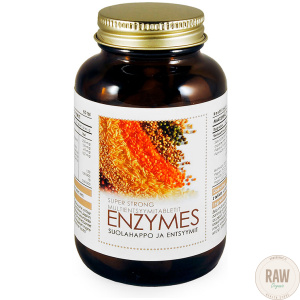
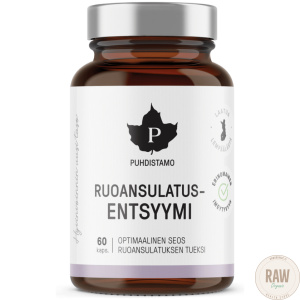
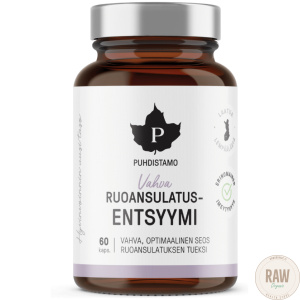
Bulking agent (calcium carbonate), betaine hydrochloride, pancreatin enzyme blend (amylase, protease, lipase, bromelain, papain, cellulase, pepsin), ox bile extract, papaya fruit powder, glazing agent (hydroxypropyl methylcellulose), anti-caking agent (magnesium salts of fatty acids), stabiliser (fatty acids [vegetable stearic acid]), glazing agents (talc, polyethylene glycol)
| per daily dose (1 tbl) | |
|---|---|
| Hydrochloric acid ( betaine hydrochloride ) | 200 mg |
| Ox bile extract (min. 42 % cholic acid) | 100 mg |
| Papaya fruit extract | 45 mg |
| Pancreatin enzyme blend | 182 mg |
| - of which amylase | 20000 USP |
| - protease | 20000 USP |
| - lipase | 1600 USP |
| - bromelain | 120 GDU |
| - papain | 100000 FCC CU |
| - cellulase | 10 FCC CU |
| - pepsin | 500000 FCC PU |
Product information is based on details provided by the manufacturer, and the manufacturer may change the composition. Always check the ingredients, nutritional information and directions on the package before use.
| Weight | 0,07 kg |
|---|---|
| Ingredients | Täyteaine (kalsiumkarbonaatti), betaiinihydrokloridi, pankreatiini entsyymiseos (amylaasi, proteaasi, lipaasi, bromelaiini, papaiini, sellulaasi, pepsiini), häränsappiuute, papaija hedelmäjauhe, pintakäsittelyaine (hydroksipropyylimetyyliselluloosa), paakkuuntumisenestoaine (rasvahappojen magnesiumsuolat), stabilointiaine (rasvahapot [kasviperäinen steariinihappo]), pintakäsittelyaineet (talkki, polyeteeniglykoli). |
| Age group | |
| Gender | |
| Unit | kpl |
| Best before date and batch number | Marked on the package |
Available for collection: Skanssi, Mylly, Hansa
Available for collection in all stores
Available for collection: Skanssi

Reviews
There are no reviews yet