Only 79,00€ away from free shipping
No products in the cart.

19,99 €
Out of stock
Out of stock
Delivery time unknown – please ask customer service. verkkokauppa@raworganic.fi
This blend of excellent skincare oils came about at the request of users. Nobody asked for exactly this, admittedly, but many seemed to be after ozonated sea buckthorn oil in particular. I had good reasons, however, for not wanting to make ozonated sea buckthorn oil. The reason is that the good skincare properties of sea buckthorn oil are mostly due to the omega-7 fatty acids it contains, which are hardly found in any other oils. Omega-7 means that the fatty acid’s carbon chain has a double bond at the seventh position counting from the end. It is precisely this bond that ozone would react with, forming an ozonide. The result would of course have the good properties of an ozonated oil, but at the same time the naturally good properties of sea buckthorn oil would be lost. That is why it makes more sense to blend ozonated sesame oil with non-ozonated sea buckthorn oil, since this way the desired properties of both are preserved.
The situation is similar with jojoba oil. Jojoba oil does not contain omega-7 fatty acids, but it is rich in eicosenoic acid, a long-chain fatty acid belonging to the omega-9 group, which is not present in significant amounts in most other vegetable oils. During ozonation this fat is also destroyed, and the result is an ozonide, which of course has good properties of its own. The ozonide of jojoba oil closely resembles the ozonide of olive oil. In olive oil the most important fatty acid is likewise oleic acid, which belongs to the omega-9 fats and has a shorter chain than the eicosenoic acid in jojoba oil, but is otherwise quite close to it. In other words, ozonated jojoba oil is very close to ozonated olive oil both in structure and in appearance. There is no reason to assume that it would be better for skincare, but it is clearly more expensive. Ozonated jojoba oil is nevertheless produced, and the reason is undoubtedly the images people have of the skincare properties of ordinary jojoba oil. The natural properties of jojoba oil, however, disappear during ozonation, so in that sense marketing rather expensive ozonated jojoba oil is, in my opinion, misleading to consumers.
This new White Swan oil is not based on images, however, but on numerous studies and experiences. Ozonated sea buckthorn oil or ozonated jojoba oil are therefore not good ideas, but in both cases blending the non-ozonated oil with an ozonated oil gives the good properties of all the oils.
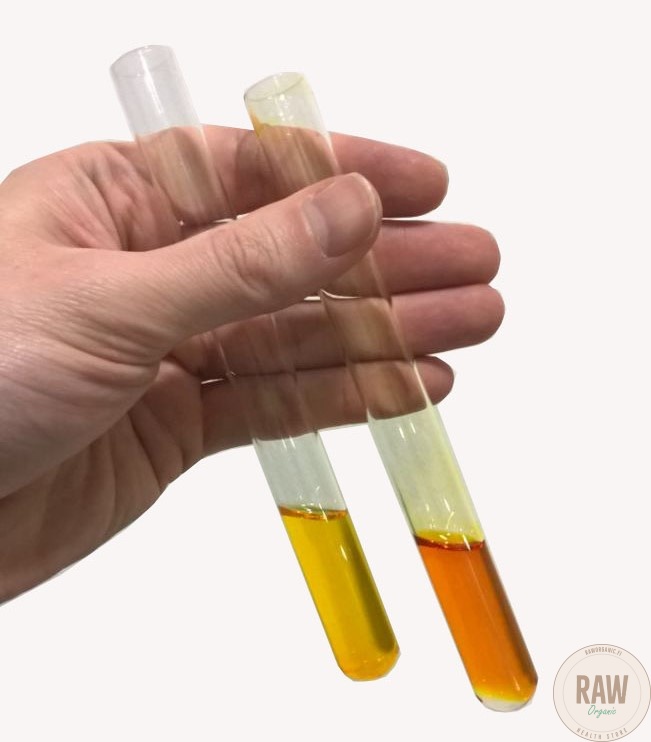
The product itself is reddish orange in colour. The colour comes from the carotenoids in sea buckthorn oil. Carotenoids are red or orange in colour, and the product may even tint the skin slightly. This may be a good or a bad feature depending on the user’s preference. When used at night, some colour may of course transfer onto bed linen, for example, although it washes out easily. The colour is not strong, though, since sea buckthorn oil is only one ingredient, and ozonated sesame oil is the most abundant component of the product. Nor is the colour entirely permanent. Carotenoids are readily oxidising compounds that slowly react with the ozonides present in ozonated oils. Even before this oil was made, it was expected that its strong colour would fade over time. This prediction proved correct, and within a few months the colour has clearly diminished. There are only small amounts of carotenoids in the oil compared with the ozonides. These reactions therefore do not substantially affect the skin-caring properties of the oil, even though the change in colour is clear. A faded oil does not mean an expired product. The accompanying picture shows samples of the oil in two test tubes. The paler shade on the left is from oil that has been stored at room temperature for three months, and the more intensely coloured sample on the right is from freshly made oil.
Ozonized Sesamum Indicum (Sesame) Seed Oil, Hippophae Rhamnoides (Sea Buckthorn) Fruit Oil, Simmondsia Chinensis (Jojoba) Seed Oil
Product information is based on details provided by the manufacturer, and the manufacturer may change the composition. Always check the ingredients, nutritional information and directions on the package before use.
| Ingredients | Ozonized Sesamum Indicum (Sesame) Seed Oil, Hippophae Rhamnoides (Sea Buckthorn) Fruit Oil, Simmondsia Chinensis (Jojoba) Seed Oil |
|---|---|
| Age group | |
| Gender | |
| Unit | kpl |
| Best before date and batch number | Marked on the package |
Available for collection: Skanssi
Available for collection: Skanssi
Available for collection: Skanssi, Mylly, Hansa
Available for collection: Skanssi, Mylly, Hansa
Available for collection in all stores
Available for collection: Skanssi

Reviews
There are no reviews yet